New York City · Personal Training & Nutrition
The Science of Resistance Training and Longevity
Why expertly programmed resistance training is the single most powerful longevity intervention available to you — and why how you train matters as much as that you train.
In an era saturated with wellness trends, biohacks, and longevity supplements, one intervention stands above all others in the peer-reviewed literature. Not cardiovascular exercise. Not fasting. Not cold plunges. Resistance training — the deliberate, progressive loading of skeletal muscle — is the single most evidence-backed tool for extending both lifespan and healthspan. The data is not subtle. It is overwhelming.
Resistance Training and All-Cause Mortality: The Numbers Are Unambiguous
The most important question in longevity science is simple: what keeps people alive longer? Multiple large-scale meta-analyses now point to the same answer.
A landmark systematic review and meta-analysis of ten cohort studies involving over 479,000 participants found that resistance training was associated with a 21% lower risk of all-cause mortality — independent of other lifestyle factors [1]. This was not a small study. Nearly half a million people. The signal is clear.
A second major meta-analysis of prospective cohort studies confirmed that muscle-strengthening activities reduced all-cause mortality by 15%, with comparable reductions across cardiovascular disease (17%), total cancer (12%), diabetes (17%), and lung cancer (19%) [2]. Resistance training does not just protect the heart — it protects against the full spectrum of chronic disease that kills people prematurely.
A large cohort of over 115,000 older adults found that muscle-strengthening activities performed at least twice per week were linked to an 11% lower all-cause mortality risk — with benefits amplified to up to 30% when combined with aerobic exercise [3].
The American Heart Association's 2023 scientific statement synthesizes this body of evidence definitively: adults who resistance train experience a 15% lower all-cause mortality risk and a 17% lower cardiovascular disease risk compared to non-participants. When resistance training is combined with aerobic exercise, mortality reductions reach 40 to 46% — a figure that no pharmaceutical intervention comes close to matching [4].
A dose-response meta-analysis published in 2024 found that even modest weight training — just 40 to 60 minutes per week — was associated with a 9 to 11% reduction in all-cause mortality risk [5]. You do not need to live in the gym. You need to show up consistently.
In a prospective cohort of over 99,000 adults, weightlifting just one to two times per week was associated with a 9 to 22% lower risk of all-cause mortality, independent of aerobic activity [6]. Resistance training works on its own. It amplifies everything else when combined.
Grip Strength: The Simplest Measure of How Long You Will Live
One of the most striking findings in longevity research is how accurately grip strength — a direct reflection of overall muscle quality and strength — predicts mortality risk. A 2024 study using NHANES data confirmed that grip strength is among the most reliable predictors of all-cause mortality across all ages and genders [7]. A separate meta-analysis of 38 studies involving nearly two million participants found that higher levels of muscular strength were associated with significantly lower all-cause mortality in apparently healthy adults [8].
In a 2015 study of almost 140,000 adults across high, middle, and low income nations, reduced handgrip strength predicted early death more accurately than blood pressure — long considered one of the best indicators of lifespan [9].
The implication is direct: building and preserving muscle strength is not just about how you look or perform. It is a measurable, trainable biomarker of how long you will live. Every session in the gym is an investment in that number.
Beyond Survival: Resistance Training and Healthspan
Longevity without quality of life is not the goal. The Centenarian Blueprint is built around thriving — not just surviving. This is where resistance training's case becomes even more compelling.
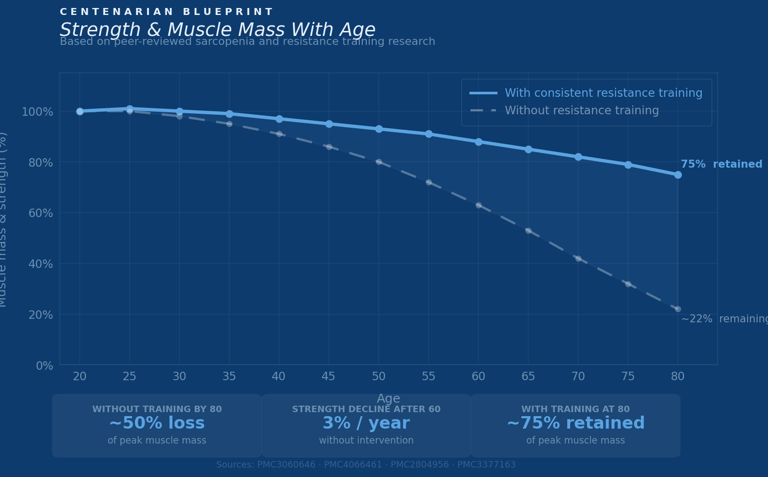
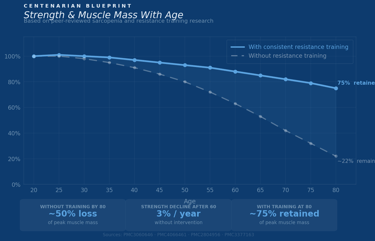
By building muscle mass, strength, and metabolic resilience, resistance training directly combats sarcopenia — the age-related loss of skeletal muscle that begins as early as the fourth decade of life and accelerates without intervention. It preserves bone density, enhances functional independence, and maintains the physical capacity that allows people to live on their own terms into advanced age.
Research also links resistance training to slower biological aging at the cellular level. One study found that strength training may preserve telomere length — the protective caps on chromosomes whose shortening is one of the most studied markers of cellular aging [10]. A comprehensive position statement from the National Strength and Conditioning Association confirmed that resistance training uniquely combats the age-related declines in muscle contractile function, fiber morphology, and neuromuscular performance that define how the body ages [11].
The research quantifies what strong people already know intuitively. Preserved muscle mass means carrying your own luggage through an airport at 75 without a second thought. Maintained bone density means hiking a trail at 70 with the same confidence you had at 40. Cardiovascular resilience means keeping up with people half your age in a city that never slows down. Grip strength that predicts longevity means opening jars, carrying bags, and moving through the world with the quiet confidence of someone who has taken care of their body for decades. The data tells you what is possible. Resistance training makes it real.
Resistance Training and the Brain: A Connection Most People Miss
The longevity benefits of resistance training extend well beyond the body. A 2024 narrative review published in Ageing Research Reviews found that resistance exercise induces structural brain changes in older adults — including increased hippocampal and cortical volume — that are directly associated with a reduced risk of Alzheimer's disease and cognitive decline [12]. These effects appear to follow a dose-response pattern, with the greatest neuroprotective benefits seen in those training at least twice per week for at least six months.
A 2025 meta-analysis of 17 randomized controlled trials confirmed that resistance training significantly improved overall cognitive function, working memory, verbal learning, and spatial memory in older adults [13]. While aerobic exercise has traditionally received more attention for brain health, the evidence for resistance training is rapidly catching up — and in certain cognitive domains, surpassing it.
The mechanism is increasingly well understood: resistance training stimulates the release of neuroprotective growth factors including IGF-1 and BDNF, promotes neuroplasticity, and reduces neuroinflammation — the same inflammatory processes implicated in Alzheimer's disease progression [14].
If you want to protect your brain as aggressively as your body, the prescription is the same. Pick up something heavy.
Lessons From the World's Longest-Lived People
The most direct evidence comes from the oldest humans alive. A 2025 intervention study demonstrated that resistance exercise restores functional capacity and improves frailty biomarkers in centenarians — people who have already lived past 100 — through personalized training [15]. A multicenter clinical trial evaluating 12 weeks of resistance training in institutionalized centenarians showed measurable improvements in muscle power, physical function, and strength [16].
These findings align with decades of evidence showing that exercise capacity and preserved muscular strength are defining hallmarks of exceptional longevity [17]. The people who reach 100 in good health are not just lucky. They have preserved the physical architecture that sustains life.
The Bottom Line
The evidence is not ambiguous. Resistance training reduces all-cause mortality by 9 to 21% across multiple large-scale meta-analyses. It protects against cardiovascular disease, cancer, diabetes, cognitive decline, and Alzheimer's disease. It preserves muscle mass, bone density, and functional independence. It slows biological aging at the cellular level. And it works — measurably, reliably, and efficiently — in as little as 40 to 60 minutes per week.
No supplement does this. No wellness trend does this. No other single intervention in the research literature produces this breadth and magnitude of benefit.
This is the science behind everything we build at Centenarian Blueprint. And it is why we treat resistance training not as one tool among many — but as the foundation of a longer, stronger life.
References
[1] Saeidifard F, et al. Resistance Training and Mortality Risk: A Systematic Review and Meta-Analysis. American Journal of Preventive Medicine. 2022. https://pubmed.ncbi.nlm.nih.gov/35599175/
[2] Momma H, et al. Muscle-strengthening activities are associated with lower risk and mortality in major non-communicable diseases. British Journal of Sports Medicine. 2022. https://bjsm.bmj.com/content/56/13/755
[3] Webber BJ, et al. Association of Leisure Time Physical Activity Types and Risks of All-Cause, Cardiovascular, Cancer, and Other Mortality Among Older Adults. JAMA Network Open. 2022. https://jamanetwork.com/journals/jamanetworkopen/fullarticle/2795598
[4] Paluch AE, et al. Resistance Exercise Training in Individuals With and Without Cardiovascular Disease: 2023 Update. Circulation / American Heart Association. 2023. https://www.ahajournals.org/doi/10.1161/CIR.0000000000001189
[5] Shailendra P, et al. Weight training and risk of all-cause, cardiovascular disease and cancer mortality among older adults. International Journal of Epidemiology. 2024. https://pmc.ncbi.nlm.nih.gov/articles/PMC11147802/
[6] Gorzelitz J, et al. Independent and joint associations of weightlifting and aerobic activity with all-cause, cardiovascular disease and cancer mortality. British Journal of Sports Medicine. 2022. https://bjsm.bmj.com/content/56/22/1277
[7] Chai L, et al. Comparison of grip strength measurements for predicting all-cause mortality among adults aged 20+ years from the NHANES 2011–2014. Scientific Reports. 2024. https://pmc.ncbi.nlm.nih.gov/articles/PMC11589676/
[8] García-Hermoso A, et al. Muscular Strength as a Predictor of All-Cause Mortality in an Apparently Healthy Population: A Systematic Review and Meta-Analysis of Data From Approximately 2 Million Men and Women. Archives of Physical Medicine and Rehabilitation. 2018. https://www.sciencedirect.com/science/article/abs/pii/S0003999317313217
[9] Leong DP, et al. Prognostic value of grip strength: findings from the Prospective Urban Rural Epidemiology (PURE) study. The Lancet. 2015. https://pubmed.ncbi.nlm.nih.gov/26096030/
[10] Arsenis NC, et al. Telomere Length and Biological Aging: The Role of Strength Training. Gerontology and Geriatric Medicine. 2024. https://pmc.ncbi.nlm.nih.gov/articles/PMC11591842/
[11] Fragala MS, et al. Resistance Training for Older Adults: Position Statement From the National Strength and Conditioning Association. Journal of Strength and Conditioning Research. 2019. https://journals.lww.com/nsca-jscr/fulltext/2019/08000/resistance_training_for_older_adults__position.1.aspx
[12] Nicola L, et al. Does resistance training in older adults lead to structural brain changes associated with a lower risk of Alzheimer's dementia? A narrative review. Ageing Research Reviews. 2024. https://pubmed.ncbi.nlm.nih.gov/38823487/
[13] Frontiers in Psychiatry. A systematic review and meta-analysis of the effects of resistance exercise on cognitive function in older adults. 2025. https://www.frontiersin.org/journals/psychiatry/articles/10.3389/fpsyt.2025.1708244/full
[14] Li F, et al. Research progress on resistance exercise therapy for improving cognitive function in patients with AD and muscle atrophy. Frontiers in Aging Neuroscience. 2025. https://pmc.ncbi.nlm.nih.gov/articles/PMC12016217/
[15] Rodriguez-Larrad A, et al. Resistance Exercise Intervention Restores Functional Capacity and Improves Frailty Biomarkers in Centenarians. The Journals of Gerontology: Series A. 2025. https://pmc.ncbi.nlm.nih.gov/articles/PMC12489740/
[16] Effects of Resistance Training in Centenarians. ClinicalTrials.gov. 2025. https://clinicaltrials.gov/study/NCT07118423
[17] Willcox DC, et al. The role of exercise capacity in the health and longevity of centenarians. Maturitas. 2013. https://pubmed.ncbi.nlm.nih.gov/22595616/


CENTENARIAN BLUEPRINT™
Thrive Longer. Age Stronger.
New York City · Personal Training & Nutrition
GET IN TOUCH
READY TO BEGIN?
Your blueprint for a longer stronger life starts with one conversation. Applications are reviewed personally and responded to within 24 hours.
© 2026 Centenarian Blueprint™. All rights reserved. · Privacy Policy · Terms & Conditions